
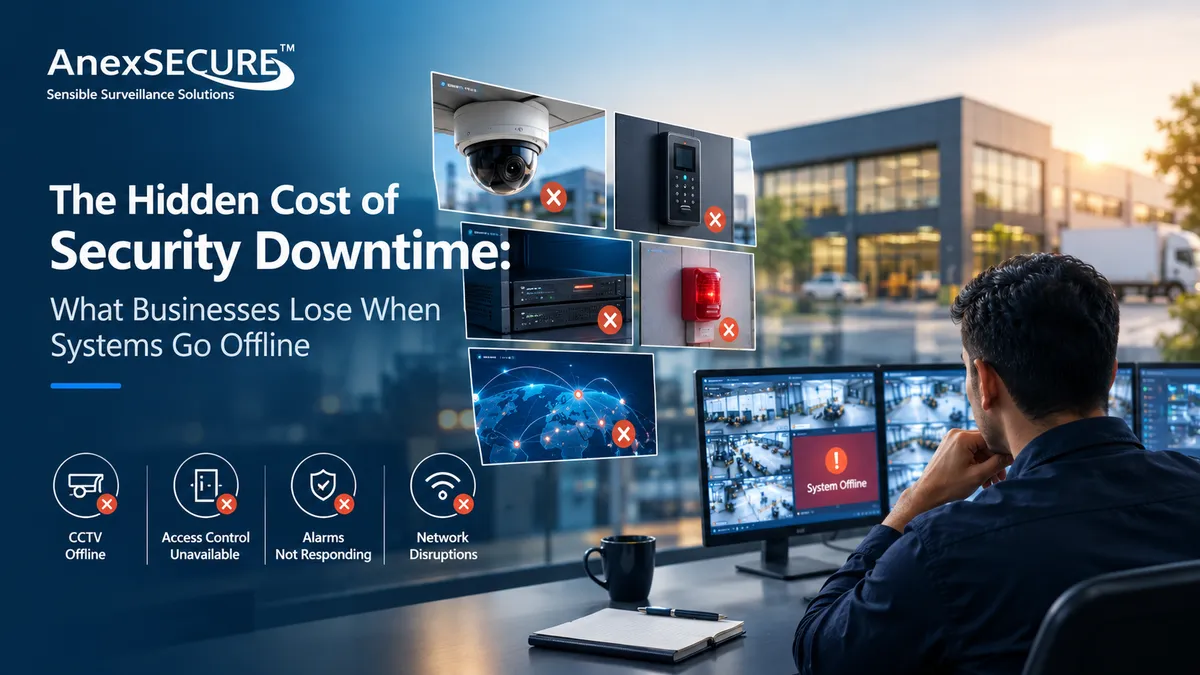
The Hidden Cost of Security Downtime: What Businesses Lose When Systems Go Offline
A security system does not have to fail completely to become a business problem.
One camera goes offline. A recording device stops storing footage. An access control reader stops responding. A network connection between locations becomes unstable. An alarm remains unavailable longer than expected.
Individually, these may appear to be minor technical issues.
But for businesses operating warehouses, retail outlets, offices, factories, branches, or multiple facilities, even a small security gap can have consequences far beyond the equipment itself.
The real cost of security downtime is not simply the cost of repairing a camera or replacing a faulty component. It can include lost visibility, delayed incident response, operational disruption, investigation difficulties, management time, and increased exposure during the period when the system is unavailable.
This is why businesses should look at security system uptime as an operational requirement—not just a technical concern.
What Does Security Downtime Actually Mean?
Security downtime occurs when one or more components of a security infrastructure are unavailable, malfunctioning, disconnected, or unable to perform their intended function.
This can involve:
CCTV cameras going offline
Recording or storage failures
Network or connectivity problems
Access control readers becoming unavailable
Intrusion alarm systems developing faults
Monitoring systems losing visibility
Communication failures between locations
Delayed troubleshooting or service response
Importantly, downtime does not always mean the entire security system has stopped working.
A business may have 50 cameras across a facility, for example, while only three cameras are offline. The remaining cameras continue operating, but those three areas have now created a potential visibility gap.
For a multi-location business, the problem can become even more difficult to identify and manage.
The First Cost: Losing Visibility When You Need It
The most obvious consequence of security downtime is the loss of visibility.
CCTV systems are often used to monitor entrances, exits, warehouses, loading areas, parking zones, production floors, retail spaces, and other sensitive areas.
When a camera or surveillance component goes offline, the business may lose visibility into that particular area.
That does not automatically mean an incident will occur. However, it does mean that the business has less information available if something does happen.
For security teams and facility managers, this creates an uncomfortable situation: the system may appear operational overall, while a specific area is effectively outside the security team's view.
This is particularly important in businesses where security infrastructure covers multiple sites and locations.
The Second Cost: Delayed Incident Response
Security systems are valuable not only because they record events, but because they can support timely awareness and response.
When a security component is unavailable, teams may have fewer signals or less information to work with. Consider a warehouse where surveillance around a loading area goes offline.
If an incident occurs during that period, security personnel may have to rely on other cameras, access records, personnel accounts, or physical inspection to understand what happened.
The issue is not simply that one camera was unavailable.
The larger problem is that the response process now has less information than it should have.
For businesses, this can make incidents harder to assess and may increase the time required to understand what happened.
The Third Cost: Investigation Becomes More Difficult
Security footage often becomes especially important after an incident.
A business may need to review footage following:
Theft or suspected theft
Unauthorized access
Property damage
Workplace incidents
Inventory discrepancies
Access violations
Disputes involving employees, visitors, or contractors
If the relevant camera was offline or recording was unavailable during the required period, the investigation may have fewer pieces of evidence to work with.
This is why recording availability and system health matter just as much as camera installation.
Installing a large number of cameras does not automatically mean a business has reliable surveillance coverage.
The system needs to remain operational and its critical components need to be monitored and maintained.
The Fourth Cost: Operational Disruption
Security infrastructure is increasingly connected to everyday business operations.
Access control systems can be used to manage entry into offices, restricted areas, warehouses, facilities, and other controlled zones.
When access control becomes unavailable, businesses may need to fall back on manual processes.
That can mean:
Manual verification
Temporary access procedures
Additional security personnel
Delays at entry points
Increased workload for facility teams
Additional coordination between departments
For a single small site, this may be manageable.
For a business with multiple facilities, repeated technical problems can create significant operational friction.
The cost is therefore not limited to the security department. Facility management, IT teams, operations teams, site managers, and employees may all become involved.
The Fifth Cost: Management Time
One of the least visible costs of security downtime is the amount of time spent managing the problem.
Someone has to identify the issue.
Someone needs to report it.
Someone has to contact the service provider.
Someone may need to coordinate with the site team.
Someone has to follow up if the issue is not resolved.
For businesses operating across several cities, this becomes even more complicated.
Instead of managing one centralized support process, teams may find themselves chasing updates from different technicians or vendors.
The equipment fault may be relatively inexpensive to fix, but the coordination effort surrounding it can become disproportionately expensive.
This is one reason structured support and centralized maintenance become increasingly important as businesses expand.
The Sixth Cost: Small Downtime Can Become a Bigger Problem
Not every security fault is immediately visible.
A camera may intermittently disconnect. A recording system may develop a storage issue. Network connectivity may become unstable. A component may continue operating but perform inconsistently.
If these issues are not detected and addressed, they can remain unnoticed until the business actually needs the system.
This creates a dangerous assumption:
“The system is installed, so it must be working.”
In reality, security infrastructure requires ongoing visibility into its operational condition.
Regular health checks, preventive maintenance, monitoring, reporting, and structured support can help businesses identify problems before they become prolonged outages.
Why Multi-Location Businesses Face a Bigger Challenge
Security downtime becomes more difficult to manage when a business operates across multiple locations. A retail company may have dozens of outlets.
A logistics business may operate warehouses and distribution centres across different cities. A manufacturing company may have plants in multiple regions.
Each location can have its own cameras, network infrastructure, access control equipment, alarms, recording systems, and local operational requirements.
Without centralized coordination, security teams can struggle to answer basic questions:
Which locations currently have system issues?
Which devices are offline?
How long has an issue been open?
Has a technician been assigned?
What is the expected response?
Which issues are recurring?
Which locations require preventive attention?
This is where centralized security support can make a practical difference.
What Businesses Should Do to Reduce Security Downtime Reducing downtime is not about assuming that equipment will never fail.
Security infrastructure consists of physical devices, networks, recording systems, software, power, connectivity, and other components. Technical issues can occur.
The objective should be to detect issues, respond to them, and restore service in a structured manner.
Businesses should consider five areas.
1. Regular Preventive Maintenance
Waiting for a component to fail before checking it creates a reactive maintenance model.
Preventive maintenance allows businesses to schedule system health checks and identify potential issues earlier.
AnexSecure's AMC services include preventive maintenance scheduling and performance checks designed to support consistent system performance.
2. Clearly Defined Service Commitments
When something goes offline, businesses need to know who is responsible and how the issue will be handled.
An SLA can define response and resolution commitments, escalation processes, and service expectations.
The exact commitments should always be agreed upon in the service contract rather than assumed.
3. Centralized Support for Multiple Locations
Businesses operating across multiple sites can benefit from having one coordinated support structure rather than managing every location independently.
AnexSecure provides centralized support coordination and on-site service support across India as part of its AMC offering.
4. Remote Diagnostics Where Possible
Some issues can be assessed remotely, depending on the architecture and available connectivity.
Remote monitoring and diagnostics can help service teams identify problems and determine whether an on-site visit is required.
This can reduce unnecessary delays between identifying a problem and beginning troubleshooting.
5. Performance Reporting
Businesses should not have to depend entirely on individual site managers to know whether their security infrastructure is functioning properly.
Performance checks and reporting can provide greater visibility into system health and recurring issues.
For larger organizations, this information can help security and facility teams prioritize maintenance instead of simply reacting to individual complaints.
Security Uptime Is About More Than Equipment
It is easy to look at security downtime as a hardware problem.
A faulty camera gets replaced.
A damaged cable gets repaired.
A network connection gets restored.
But the business impact is broader.
When a security system goes offline, the business may temporarily lose:
Visibility → Response capability → Evidence → Operational control → Management efficiency
That is why security infrastructure should be treated as part of business operations rather than as equipment that can simply be installed and forgotten.
How AnexSecure Helps Businesses Manage Security Infrastructure
AnexSecure provides security and surveillance infrastructure for businesses across India, with a focus on multi-location enterprises.
Its services include system integration, CCTV surveillance, access control, intrusion detection, centralized monitoring, AMC services, and pan-India project execution.
For ongoing maintenance, AnexSecure's AMC offering includes:
Preventive maintenance scheduling
SLA-based response and resolution
Centralized support coordination
Remote monitoring and diagnostics
On-site service support across India
Performance checks and reporting
These capabilities are designed to help businesses move from purely reactive maintenance toward a more structured approach to security system reliability.
AnexSecure also states that it has over 35 years of combined domain experience, 5,000+ solutions delivered, 20,000+ devices installed, and a 24–48 hour response capability across India.
For businesses with multiple locations, the objective is not simply to install security equipment. It is to maintain a security infrastructure that remains visible, supported, and operational as the business grows.
Questions Businesses Should Ask About Security Downtime
Before choosing a security system partner or maintenance provider, decision-makers should ask:
How are system failures detected?
Is preventive maintenance included?
What happens when a critical camera or access control device goes offline?
Are response and resolution expectations documented in an SLA?
Can issues be diagnosed remotely where the system permits?
Who coordinates support across multiple locations?
Are service activities and system performance reported?
How are recurring technical issues identified?
Is on-site support available across the required locations?
What happens after installation when the system needs ongoing support?
These questions shift the conversation from “What equipment are we buying?” to “How reliably will our security infrastructure operate?”
That is a much more important question for businesses.
FAQs
What is security system downtime?
Security system downtime occurs when part or all of a security infrastructure is unavailable or unable to perform its intended function. It can involve CCTV cameras, recording systems, access control, alarms, connectivity, or monitoring infrastructure.
Why is CCTV downtime a business risk?
CCTV downtime can create gaps in visibility and may reduce the information available during an incident or investigation. The impact depends on which equipment is affected, how long it remains unavailable, and the importance of the area being monitored.
Can preventive maintenance reduce security downtime?
Preventive maintenance can help identify equipment and system issues before they develop into more serious failures. It cannot eliminate every possible fault, but it can support more reliable system operation.
What is the role of an AMC in reducing downtime?
An Annual Maintenance Contract can provide a structured framework for preventive maintenance, troubleshooting, service response, reporting, and ongoing technical support. The exact scope depends on the agreement.
Is security downtime more difficult for multi-location businesses?
It can be. Businesses operating across multiple sites have more equipment, locations, networks, and service requirements to coordinate. Centralized support can simplify monitoring, escalation, and maintenance management.
What should businesses look for in a security maintenance partner?
Look for preventive maintenance, clearly defined SLA commitments, centralized coordination, remote diagnostics where applicable, on-site support, performance reporting, and experience managing the type and scale of your security infrastructure.
Final Thoughts
Security downtime is easy to underestimate because the immediate problem may look small.
One camera. One access reader. One network connection. One recording issue.
But when that equipment supports a larger security operation, even a small failure can create a gap in visibility and add operational work for the business.
The goal should not be to assume that security systems will never fail.
The goal is to have the right infrastructure, monitoring, maintenance, support processes, and accountability in place so that problems can be identified and addressed before they become prolonged operational gaps.
For businesses managing security across multiple locations, that reliability becomes even more important.
Because the real cost of security downtime isn't just the repair bill. It's what the business loses while the system isn't there when it is needed.
If your business operates across multiple locations and you want to assess the reliability and support structure of your security infrastructure, speak with AnexSecure about your requirements.