
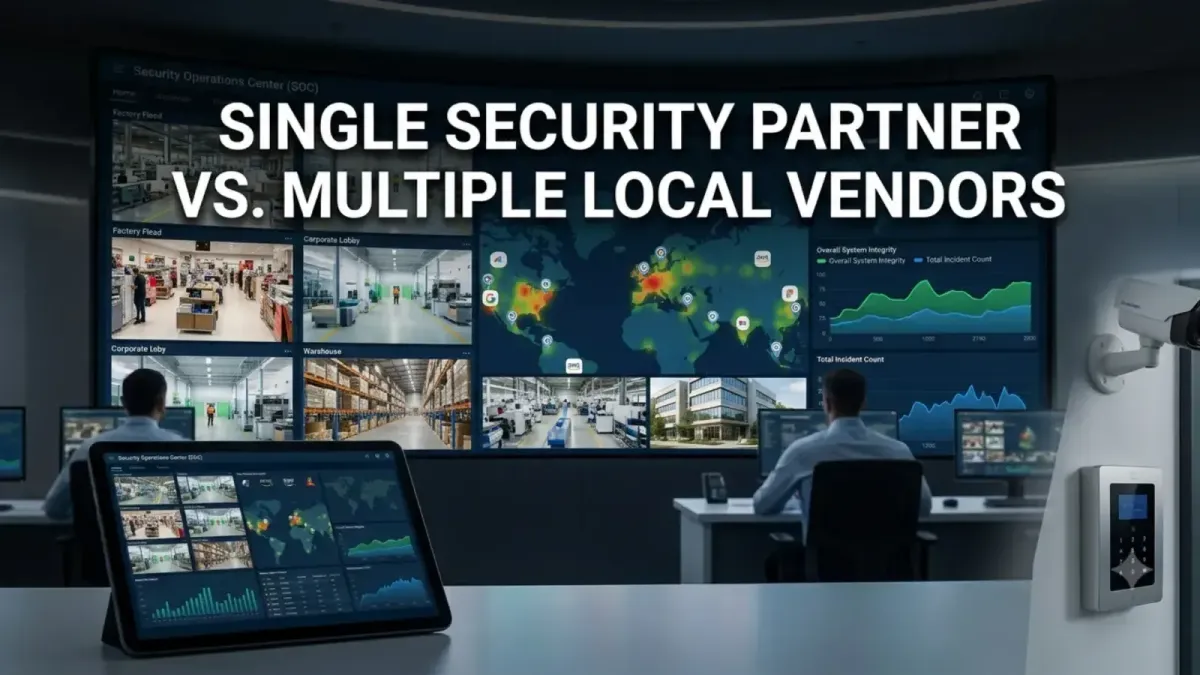
Single Security Partner vs Multiple Local Vendors: Which Is Better?
Managing security infrastructure across multiple business locations can become complicated very quickly.
A company with offices, warehouses, retail outlets, manufacturing facilities, or branches across different cities may need CCTV surveillance, access control, intrusion alarms, networking, centralized monitoring, and ongoing maintenance at every location.
This raises an important question:
Is it better to work with one security system integrator across all locations, or manage multiple local security vendors independently?
For a single facility, a local vendor may appear to be the simplest option. But as the number of locations increases, managing multiple vendors can create challenges around coordination, maintenance, reporting, service response, system standards, and accountability.
A single security partner can provide a more centralized approach to designing, deploying, maintaining, and supporting security infrastructure across locations.
For multi-location enterprises, the choice is therefore not simply about who can install a CCTV camera. It is about who can manage the complete security infrastructure lifecycle.
Single Security Partner vs Multiple Local Vendors
Before comparing the two approaches, it is important to understand how they work.
Multiple Local Vendors
Under this model, an organization may appoint different vendors for different locations.
One vendor may handle CCTV at a warehouse, another may maintain access control at a corporate office, while different local providers may support retail outlets in different cities.
This can work for smaller or highly localized operations, but as the organization expands, the number of vendor relationships can increase significantly.
Single Security Partner
With a single security partner, the organization works with one provider for its security infrastructure across multiple locations.
Depending on the provider's capabilities, this can include:
Security system design
CCTV installation
Access control
Intrusion detection
Fire alarm integration
Network and connectivity integration
Centralized monitoring
Project execution
Preventive maintenance
Technical support
AMC services
AnexSecure's current service portfolio covers system integration, AMC services, project execution, CCTV surveillance, intrusion alarm systems, and access control and attendance systems. Its system integration service also includes network integration and centralized monitoring.
The Challenges of Managing Multiple Local Security Vendors
Multiple vendors are not necessarily a bad choice. Local providers can have strong knowledge of their respective markets and may be suitable for individual sites.
The challenge arises when an enterprise has to coordinate several vendors across many locations.
1. Different Standards Across Locations
When different vendors install security systems at different locations, there may be variations in:
Equipment configuration
Installation practices
System architecture
Documentation
Maintenance schedules
Monitoring processes
Troubleshooting procedures
Over time, this can make the organization's security infrastructure less standardized.
A centralized security partner can instead work toward consistent deployment and maintenance practices across locations.
AnexSecure specifically positions its system integration services for both single- and multi-location businesses, with a focus on integrated security systems and centralized control.
2. Too Many Points of Contact
Imagine an enterprise operating 100 locations.
If every location has a separate security vendor, the organization may have to maintain multiple contacts for installation, maintenance, troubleshooting, and service escalation.
When a problem occurs, the first challenge may simply be identifying who is responsible. A single security partner creates a centralized point of coordination.
AnexSecure's AMC service specifically highlights single vendor management and centralized support coordination as benefits for businesses managing security systems across locations.
3. Maintenance Becomes Harder to Coordinate
Security systems require more than installation.
CCTV cameras, recording systems, access control equipment, intrusion detection systems, networks, and related infrastructure need appropriate maintenance and periodic checks.
With multiple vendors, maintenance schedules and service processes can vary between locations. A centralized AMC approach can provide a more structured maintenance process.
AnexSecure's AMC offering includes preventive maintenance scheduling, SLA-based response and resolution, centralized support coordination, remote monitoring and diagnostics, on-site support across India, and performance checks and reporting.
4. Troubleshooting Can Become Complicated
Security systems are increasingly interconnected.
A CCTV issue, for example, may not always originate with the camera itself. Depending on the system architecture, the issue could involve networking, connectivity, recording infrastructure, power, or another component.
When different vendors manage different parts of the infrastructure, identifying responsibility can become more complicated.
An integrated security system provider can approach the problem from a broader system perspective.
AnexSecure's system integration offering includes IP-based CCTV, network and connectivity integration, centralized monitoring, access control, attendance, fire alarm and intrusion detection integration.
Where a Single Security Partner Has an Advantage
A single partner can offer several operational advantages for businesses with distributed locations.
1. Centralized Coordination
Instead of coordinating with multiple independent vendors, the enterprise has a single primary partner responsible for the agreed security services.
This can simplify communication, escalation, reporting, and service management.
It does not eliminate every operational issue, but it can reduce the administrative complexity of managing multiple service relationships.
2. More Consistent Deployment
A single integrator can apply common design and deployment principles across locations.
This becomes particularly valuable when an enterprise wants its security infrastructure to follow common standards as it expands.
AnexSecure's system integration approach includes site assessment, solution design, deployment, commissioning, network integration, and centralized monitoring configuration.
3. Easier Multi-Location Maintenance
For organizations with geographically distributed facilities, maintenance is a major consideration.
A centralized AMC partner can coordinate preventive maintenance and service requests across locations rather than leaving each branch or facility to manage maintenance independently.
AnexSecure describes its AMC service as centralized maintenance and SLA-driven support for security systems across locations, with on-site support across India.
4. Better Visibility Across the Security Infrastructure
Centralized monitoring can help organizations move away from isolated security systems at individual locations.
Instead of treating every branch or facility as a completely separate environment, businesses can build a more connected security infrastructure.
AnexSecure's system integration service includes centralized monitoring configuration and describes centralized monitoring as a way to manage and monitor locations from a single secure platform.
Does One Partner Always Mean Lower Cost?
Not necessarily.
Cost should not be the only factor when comparing a single security partner with multiple local vendors.
A multi-vendor approach may sometimes appear cheaper at the individual-site level because businesses can negotiate separately with local providers.
However, enterprises should consider the total operational effort involved in managing multiple vendors. This can include:
Vendor coordination
Service follow-ups
Multiple maintenance agreements
Different reporting formats
Escalation management
Site-level troubleshooting
Different installation standards
Contract management
The better question is therefore not simply:
"Which option has the lowest installation price?"
Instead, ask:
"Which approach provides the right balance of reliability, manageability, scalability, and long-term operational control?"
Single Partner vs Multiple Vendors: A Practical Comparison
Factor | Single Security Partner | Multiple Local Vendors |
Vendor coordination | Centralized | Multiple contacts |
Factor | Single Security Partner | Multiple Local Vendors |
Deployment standards | Easier to standardize | May vary by vendor |
Maintenance management | Centralized | Managed separately |
Service escalation | Single coordination point | Multiple escalation paths |
Multi-location support | Designed for centralized management | Requires vendor-by-vendor coordination |
Reporting | Can be standardized | May use different formats |
System integration | One partner can coordinate multiple systems | May involve multiple parties |
Expansion | Easier to replicate a common approach | New vendor coordination may be required |
Accountability | More centralized | Distributed across vendors |
The right model ultimately depends on the organization's size, geographic footprint, security requirements, and internal resources.
When Multiple Local Vendors May Still Make Sense
A balanced comparison is important. Multiple local vendors can make sense when:
The organization operates only a few locations.
Sites have significantly different security requirements.
Local expertise is particularly important for specific facilities.
The organization already has strong internal technical management.
Different specialist vendors are required for specific systems.
There is no need for centralized management.
The issue is not that local vendors are inherently ineffective.
The issue is complexity at scale.
As the number of locations, systems, and vendors increases, centralized coordination can become increasingly valuable.
Why Multi-Location Enterprises Need a Different Approach
Retail chains, logistics companies, financial institutions, manufacturing organizations, and enterprises with distributed facilities face a different security challenge from single-site businesses.
The security infrastructure has to operate across locations while remaining manageable at an organizational level.
AnexSecure's AMC services specifically identify logistics networks, retail chains, and banking and financial institutions among the industries it supports.
Its system integration services also highlight logistics and distribution, retail chains, commercial and enterprise businesses, education, and manufacturing.
For these organizations, the value of a security partner goes beyond installing equipment.
The partner needs to understand deployment, integration, monitoring, maintenance, and ongoing support.
What to Look for in a Single Security Partner
If an enterprise decides that centralized security management is the better approach, it should evaluate the provider carefully.
Look for a partner that offers:
End-to-End Integration
The provider should be capable of handling assessment, design, installation, integration, and commissioning.
Multi-Location Capability
The provider should have the operational capability to support deployments across multiple cities and locations.
Multiple Security Technologies
Look beyond CCTV alone. Evaluate capabilities in access control, intrusion detection, networking, monitoring, and related systems.
Centralized Monitoring
A centralized monitoring approach can provide better visibility across distributed security infrastructure.
AMC and Preventive Maintenance
Post-installation support is essential. Look for preventive maintenance, defined service processes, reporting, and escalation mechanisms.
SLA-Driven Support
Service-level agreements should clearly define applicable response and resolution commitments.
Project Execution Capability
For large deployments, the provider should have the ability to coordinate installation, rollout, commissioning, and on-ground technical support.
AnexSecure's current offering includes these capabilities across system integration, AMC, and project execution.
Why AnexSecure Fits the Single-Partner Model
AnexSecure positions itself as a security and surveillance system integration company serving enterprises across India.
Its services combine system integration, AMC services, project execution, CCTV surveillance, intrusion alarm systems, access control, and attendance systems.
For multi-location businesses, the company also highlights centralized monitoring, PAN-India execution capability, and SLA-driven support.
Its website states that AnexSecure has 35+ years of combined domain experience, 5,000+ solutions delivered, and 20,000+ devices installed, along with a stated 24–48 hour response time across India.
Its AMC service further provides preventive maintenance, centralized support coordination, remote monitoring and diagnostics, on-site support across India, and performance reporting.
Together, these capabilities position AnexSecure to support the security lifecycle from design and deployment to maintenance and ongoing service.
FAQs
Is it better to have one security vendor for multiple locations?
For many multi-location enterprises, a single security partner can simplify coordination, maintenance, reporting, and service management. However, the right choice depends on the organization's requirements and the provider's actual capabilities.
Are multiple local CCTV vendors a bad idea?
Not necessarily. Local vendors can work well for individual sites or smaller businesses. The challenge can arise when many vendors need to be coordinated across a large number of locations.
What are the benefits of a single security system integrator?
Potential benefits include centralized coordination, more consistent deployment, integrated security systems, simplified maintenance, centralized monitoring, and a single point of service management.
Can one security partner manage CCTV and access control?
Yes, where the provider offers integrated security services. AnexSecure provides CCTV surveillance, access control and attendance systems, intrusion alarm systems, and system integration.
Does AnexSecure provide security AMC services across India?
AnexSecure's AMC offering includes centralized maintenance, SLA-driven support, remote diagnostics, performance reporting, and on-site service support across India.
Is a single security partner suitable for large enterprises?
It can be particularly useful for organizations with multiple locations that need centralized coordination, consistent deployment, and structured maintenance and support.
Final Thoughts
The choice between one security partner and multiple local vendors ultimately depends on the scale and complexity of the business.
For a small number of independent locations, multiple local providers may be practical.
But for enterprises operating across cities, states, or hundreds of facilities, managing security through multiple disconnected vendors can create additional coordination and maintenance complexity.
A capable single security system integrator can bring together system design, deployment, integration, centralized monitoring, project execution, AMC, and technical support under a more coordinated model.
The goal is not simply to reduce the number of vendors.
It is to create a security infrastructure that is easier to manage, easier to scale, and better aligned with the organization's operational requirements.
For businesses looking for a centralized approach to security infrastructure across multiple locations, AnexSecure provides system integration, AMC, centralized monitoring, and PAN-India execution capabilities.
Looking to simplify security management across multiple locations? Connect with AnexSecure to discuss your requirements.