
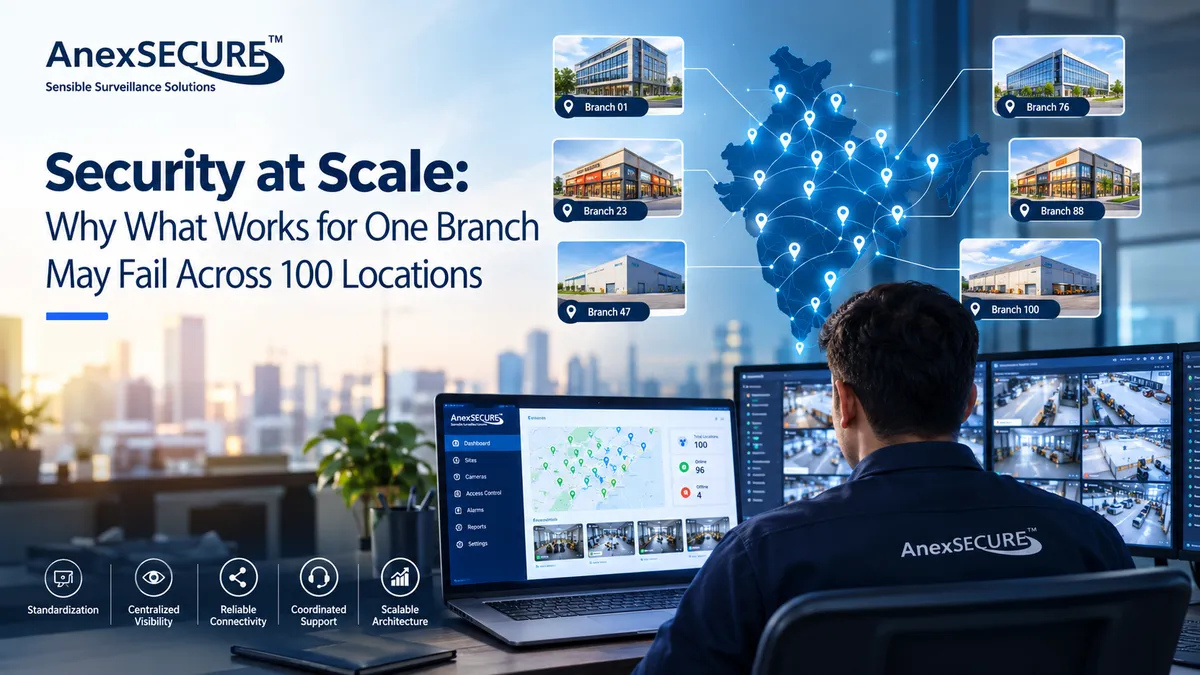
Security at Scale: Why What Works for One Branch May Fail Across 100 Locations
A security system that works well at one branch can be perfectly adequate for that location. The problem begins when the business grows.
One branch becomes ten. Ten become fifty. Fifty become a hundred.
Suddenly, the question is no longer simply:
“Does the security system work?”
The more important question becomes:
“Can the same level of security, visibility, support, and control be maintained across every location?”
This is where many businesses discover that a security solution designed for a single site does not necessarily scale effectively.
The cameras may still work. The access control may still function. The alarms may still operate.
But managing the entire security infrastructure consistently across 100 locations is a very different challenge.
For multi-location businesses, security at scale requires more than adding more devices. It requires standardization, centralized visibility, reliable connectivity, coordinated support, and a system architecture that can grow with the organization.
The Difference Between One Site and 100 Sites
At a single branch, security management is relatively straightforward.
A facility manager may know:
•Where the cameras are installed
•Which areas they cover
•Who maintains the system
•Which equipment occasionally has issues
•Who to call when something stops working
There may be only one site team, one network environment, and one service relationship to manage. 1
Now multiply that by 100.
A business could potentially have hundreds or thousands of cameras, numerous access control points, multiple recording systems, different network environments, different site teams, and service requirements spread across cities.
The challenge is no longer installation.
It is consistency and control at scale.
Why a Single-Branch Solution May Not Scale
A security solution designed for one location is often optimized around that site's specific requirements. That can work well.
But when the organization expands, several problems can appear.
1. Every Location Starts Doing Things Differently
One branch may use one camera configuration.
Another may use a different model.
A third may have a different recording setup.
Another location may have a different access control configuration.
This can happen naturally as businesses expand, especially when each new site is handled independently. Over time, the organization can end up with multiple standards.
That creates challenges for security teams because managing 100 locations becomes less predictable.
A centralized security strategy should ideally define standards for equipment, deployment, configuration, documentation, and support wherever practical.
The objective isn't necessarily to make every location identical.
It is to ensure that differences are deliberate rather than accidental.
2. Visibility Becomes Fragmented
At one branch, checking the status of a security system may be relatively simple.
At 100 branches, it becomes much harder to maintain the same visibility.
Security and facility teams may need to know:
•Which locations have operational issues?
•Which cameras are unavailable?
•Which sites need service?
•Are there recurring problems?
•Which issues remain unresolved?
•Which locations require preventive maintenance?
Without appropriate centralized monitoring or reporting, teams can end up relying heavily on individual branch managers to report problems.
That introduces another risk:
A system can be unavailable without the central team immediately knowing about it. The larger the organization becomes, the more important centralized visibility becomes.
3. Network and Connectivity Become Critical
Security infrastructure does not operate in isolation.
IP-based CCTV, centralized monitoring, remote diagnostics, access control, and other connected systems can depend on network infrastructure and connectivity.
At one site, a network issue may affect one facility.
Across 100 locations, network variation becomes a major consideration.
Different branches may have:
•Different internet providers
•Different network configurations
•Different bandwidth availability
•Different IT support arrangements
•Different physical environments
This means a scalable security solution needs to consider connectivity as part of the overall architecture— not as an afterthought.
Security and IT teams may need to work together to ensure that the infrastructure can support the intended security functionality.
4. Maintenance Becomes a Coordination Problem
At one location, calling a technician is relatively simple.
At 100 locations, maintenance becomes an operational process.
Imagine that ten branches experience security-related issues during the same month.
Without centralized coordination, different locations may contact different technicians, follow different processes, and receive different levels of support.
This can make it difficult for management to answer basic questions:
What is broken?
Who is handling it?
How long has it been open?
Has the issue been resolved?
Is the same problem happening elsewhere?
For multi-location organizations, structured maintenance and centralized support can help reduce this complexity.
5. Local Vendors Can Create Inconsistent Standards
Local vendors can be useful, particularly when a business has straightforward requirements in a specific geographic area.
However, as the number of locations grows, independently managing multiple vendors can create challenges around:
• •
Equipment standards
Installation quality
• • • • •
Documentation
Response processes Maintenance schedules Reporting Escalation
The issue is not that local vendors are inherently unsuitable.
The issue is that 100 locations can become difficult to manage when there is no overarching security standard or coordination layer.
A growing organization needs to decide how much local flexibility it wants and where it needs centralized control.
6. Troubleshooting Becomes More Difficult
A single-site security system is easier to understand because the number of components and dependencies is limited.
At scale, troubleshooting can involve several layers.
For example, if a camera is unavailable, the issue could involve:
Camera → PoE/network → Switch → Connectivity → Recording system → Monitoring environment The problem may not actually be the camera itself.
This is why experience with integrated security infrastructure becomes increasingly important as deployments grow.
A scalable approach should consider the relationship between security devices, network infrastructure, recording, monitoring, and support.
7. Adding New Locations Becomes Slower
Growth creates another challenge.
Businesses rarely stop at the locations they have today.
A retail chain may open new outlets.
A logistics company may add warehouses.
A financial organization may expand its branch network.
A manufacturing business may establish new facilities.
If every new site requires a completely new security design and implementation process, deployment can become slower and more difficult to manage.
A scalable security architecture should make it easier to replicate an established standard while still adapting to the specific requirements of each site.
This can make expansion more structured.
What Security at Scale Should Look Like
A scalable security infrastructure does not necessarily mean installing the most expensive equipment at every location.
It means designing an environment that can be managed consistently as the organization grows. Depending on the business and requirements, this may include:
Standardized Solution Design
Define preferred security technologies, configurations, installation practices, and documentation standards.
Centralized Monitoring
Create appropriate visibility across locations so that security teams can better understand system status and respond to issues.
Integrated Security Systems
CCTV, access control, intrusion detection, and other relevant systems should be designed to work as part of a broader security infrastructure where required.
Reliable Connectivity
Network and connectivity requirements should be considered during solution design, particularly for IP based systems and centralized monitoring.
Structured Maintenance
Preventive maintenance schedules, service processes, reporting, and escalation procedures become increasingly important as the number of locations increases.
Scalable Deployment
New locations should be able to follow an established framework rather than starting from scratch every time.
The Importance of Centralized Support
One of the biggest advantages of a coordinated security infrastructure is having a clear support structure.
Instead of each location independently managing security issues, the organization can establish centralized coordination for maintenance and service.
AnexSecure's AMC services include centralized support coordination, preventive maintenance scheduling, SLA-based response and resolution, remote monitoring and diagnostics, on-site service support across India, and performance checks and reporting.
This approach can be particularly relevant to organizations where security infrastructure is distributed across multiple locations.
The goal is not simply to fix equipment when it fails.
It is to create a more structured way to manage the security infrastructure throughout its operational lifecycle.
Scaling Security Without Losing Local Flexibility
Standardization does not mean every branch needs to be exactly the same.
A warehouse may have very different security requirements from a retail outlet. A corporate office may require different access control arrangements from a manufacturing facility. A distribution centre may require broader surveillance coverage than a small branch.
The better approach is often to establish a common security framework while allowing individual locations to be configured according to their specific operational requirements.
For example:
Common framework
• •
Preferred technologies
Security standards
• •
Documentation
Support process
• •
Maintenance approach Escalation structure
Location-specific requirements
•Camera placement
•Coverage areas
•Access points
•Site layout
• •Network conditions
Operational risks
This gives the business both consistency and flexibility. 7
What Happens When Security Is Not Designed for Growth?
When security infrastructure is designed one branch at a time without considering future expansion, businesses can gradually accumulate technical and operational complexity.
They may have:
•Multiple equipment standards
•Different service providers
•Different maintenance contracts
•Inconsistent documentation
•Limited centralized visibility
•Different monitoring arrangements
•Varying response processes
None of these problems necessarily appears on day one.
They emerge as the organization grows.
This is why security planning should consider not only where the business is today, but also how the security environment will be managed when the organization has 20, 50, or 100 locations.
How AnexSecure Supports Multi-Location Security Infrastructure
AnexSecure specializes in security and surveillance infrastructure for businesses operating across India.
Its services include system integration, CCTV surveillance, intrusion alarm systems, access control and attendance systems, centralized monitoring, AMC services, and project execution support.
Its system integration approach covers site assessment, solution design, IP-based CCTV deployment, access control and attendance, intrusion and fire alarm integration, network/connectivity integration, centralized monitoring configuration, installation, and commissioning.
For organizations expanding across multiple locations, this broader approach can help bring different parts of the security infrastructure into a coordinated framework.
AnexSecure states that it has delivered more than 5,000 solutions and installed more than 20,000 devices, with 35+ years of combined domain experience.
The company's service offering is built around supporting security infrastructure beyond the initial installation, including ongoing maintenance and project execution across India.
Questions to Ask Before Scaling Your Security Infrastructure
If your business is expanding from one location to multiple branches, ask:
1.Can our current security architecture be replicated across new locations?
2.Are we using consistent security standards?
3.Can our security team get visibility across locations?
4.How are network and connectivity requirements being handled?
5.Who owns troubleshooting when multiple systems are involved?
6.Do we have centralized maintenance coordination?
7.Are service and escalation processes clearly defined?
8.Can the system accommodate additional locations?
9.Are our security systems documented consistently?
10.What happens when the number of locations doubles?
These questions can reveal whether the current security setup is genuinely scalable—or simply being repeatedly replicated without a long-term strategy.
FAQs
Can a security system designed for one branch be used across multiple locations?
It can potentially be replicated, but that does not automatically mean it is scalable. Multi-location deployments introduce additional requirements around standardization, connectivity, monitoring, maintenance, documentation, and support.
Does every branch need identical security equipment?
Not necessarily. Different sites may have different layouts, risks, operational requirements, and connectivity conditions. A common security framework can be combined with location-specific design.
Why is centralized monitoring important for multi-location businesses?
Centralized monitoring can provide greater visibility across locations and help security teams identify and manage issues without relying entirely on individual branches to report them.
How does network infrastructure affect multi-location CCTV?
IP-based CCTV and centralized security systems can depend on network connectivity. Network design, bandwidth, connectivity, and configuration should therefore be considered during security planning.
When should a business start planning for scalability?
Ideally, scalability should be considered before the organization begins rapidly expanding. Designing the security framework early can reduce the risk of accumulating inconsistent systems as new locations are added.
Is a single security partner always better for 100 locations?
Not necessarily. The right model depends on the organization's requirements. However, businesses with many locations should have clear standards, ownership, escalation, support, and coordination regardless of whether they use one provider or multiple providers.
Final Thoughts
Security at one branch is primarily a site-level challenge.
Security across 100 locations is an infrastructure and management challenge.
What works perfectly at one location may become difficult to monitor, maintain, standardize, and support when multiplied across an entire business network.
The solution is not simply to install more cameras.
It is to think about security as a scalable infrastructure—with consistent standards, appropriate technology, reliable connectivity, centralized visibility, structured maintenance, and clear accountability.
Because when a business grows from one location to 100, its security strategy needs to grow with it.
The goal isn't to make 100 branches operate exactly the same. It's to make sure they can all be managed with the same level of control, visibility, and confidence.
If your business is expanding across multiple locations, AnexSecure can help assess your security infrastructure and build a scalable approach around your operational requirements.