
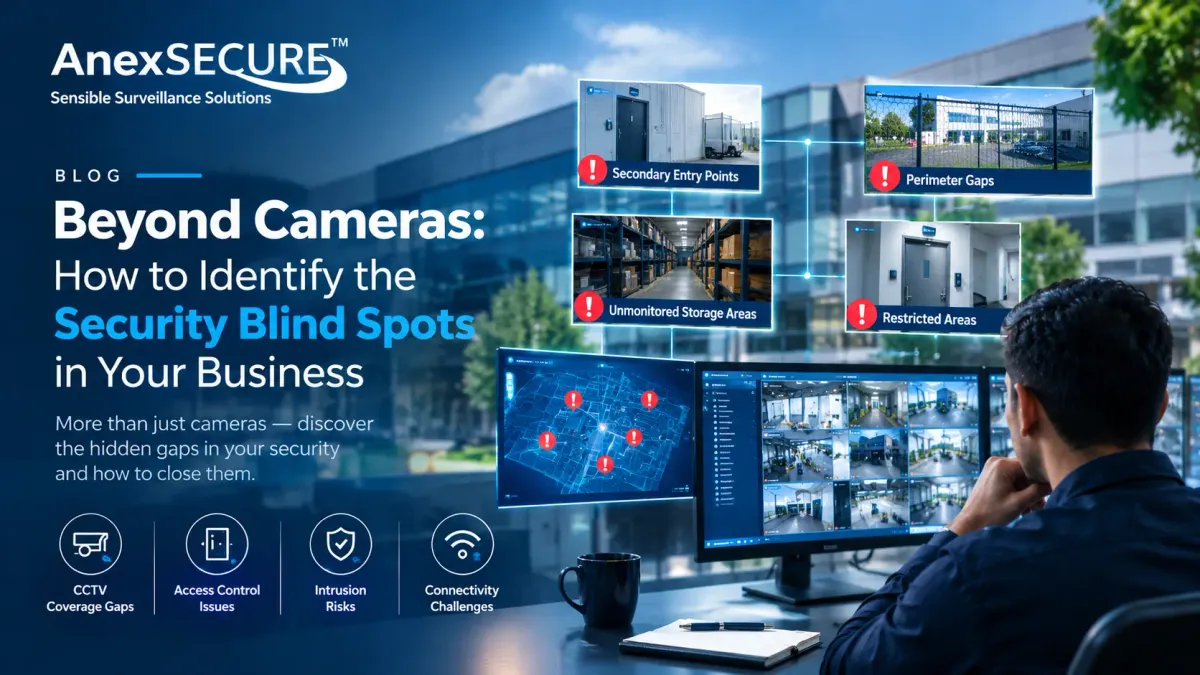
Beyond Cameras: How to Identify the Security Blind Spots in Your Business
A business can have dozens of CCTV cameras installed and still have security gaps it doesn't know about.
An entrance may be monitored, but a nearby access point may not be. A warehouse may have extensive camera coverage, but certain storage areas may remain difficult to observe. Access control may be installed at the main entrance, while movement into restricted areas is managed differently.
These gaps are not always caused by poor equipment. Sometimes, they develop because security systems are installed without a complete understanding of how people, assets, and operations move through a facility.
For businesses, the important question isn't simply how many cameras are installed. It's whether the security infrastructure addresses the risks that matter most.
Identifying security blind spots requires businesses to look beyond individual devices and assess how their entire premises are monitored, accessed, and protected.
In this article, we'll explore common security blind spots, how businesses can identify them, and what to consider when planning a more effective security infrastructure.
What Are Security Blind Spots?
A security blind spot is an area, activity, or process that lacks adequate visibility, monitoring, or access control for the level of risk involved.
The term is often associated with CCTV cameras, but security blind spots can extend beyond video surveillance.
They may include:
Physical areas that aren't adequately covered by cameras.
Entry points that lack appropriate access controls.
Restricted areas where access permissions are unclear.
Locations where security alerts aren't communicated effectively.
Critical areas where recording availability hasn't been verified.
Gaps between surveillance, access control, and intrusion detection.
Facilities where nobody has a clear process for reviewing security issues.
Not every area needs the same level of monitoring. A reception area, a warehouse loading bay, a server room, and a staff break room have different operational and privacy considerations.
The objective is to identify where security gaps could create meaningful risks and address them according to the business's requirements.
1. Focusing on Camera Quantity Instead of Coverage
One common mistake is evaluating a CCTV installation primarily by the number of cameras.
A proposal with more cameras may appear to offer better protection, but camera quantity alone doesn't establish whether the required areas are adequately covered.
Camera placement, viewing angles, lighting conditions, image quality, obstructions, and the purpose of the footage all influence the usefulness of a surveillance system.
For example, a warehouse may have cameras covering the main entrance and loading bay. However, the placement may not provide sufficient visibility of a particular storage aisle or a secondary access point.
The solution isn't automatically to install more cameras everywhere.
Instead, businesses should conduct a site assessment to understand the areas that require monitoring, the activities taking place there, and the level of visibility needed.
The right question is not how many cameras a facility has, but whether the camera layout supports its security objectives.
2. Overlooking Secondary Entry and Exit Points
Main entrances naturally receive considerable attention during security planning.
However, facilities may also have emergency exits, delivery entrances, staff entrances, parking access points, service corridors, and other routes through which people can enter or leave.
Depending on the premises, these areas may require different combinations of surveillance, access control, alarms, and physical security measures.
A useful security assessment should examine how people enter and exit the facility throughout the working day, including during shift changes, deliveries, maintenance visits, and after-hours operations.
Businesses should also review whether access permissions reflect actual job responsibilities and whether changes to those responsibilities are handled appropriately.
The aim is to ensure that important access points are considered as part of the overall security plan rather than addressed individually without coordination.
3. Protecting the Perimeter but Ignoring Internal Movement
Securing the building's exterior is important, but internal movement can present different challenges.
Consider a manufacturing facility with controlled entry at the main gate. Once inside, employees, contractors, delivery personnel, and visitors may move through different operational areas.
Some areas may contain sensitive equipment, valuable inventory, confidential records, or infrastructure that requires restricted access.
If internal access requirements haven't been considered, the organization may have strong perimeter controls but limited oversight of movement within the facility.
Businesses should identify areas that require different access permissions and determine whether suitable controls are in place.
Depending on the operational requirements, this may involve access control systems, defined visitor procedures, CCTV coverage, or intrusion detection.
Security measures should reflect actual business risks without unnecessarily restricting legitimate work.
4. Assuming That Installed Systems Are Working Properly
A camera being physically present doesn't necessarily mean it is providing useful footage.
Similarly, an access control reader being installed doesn't guarantee that it is communicating correctly with the wider system.
Technical issues can affect cameras, recording equipment, connectivity, power supplies, and other components.
Businesses should therefore distinguish between having security equipment installed and verifying that it performs its intended function.
Useful checks may include:
Confirming that critical cameras are operational.
Reviewing whether footage is being recorded as intended.
Checking the condition of recording and storage components.
Verifying that access control points function correctly.
Reviewing relevant alarm and communication paths.
Maintaining records of faults and corrective action.
The appropriate checks depend on the equipment, system configuration, and business requirements.
Regular inspections and structured maintenance can help identify issues that might otherwise remain unnoticed.
5. Treating CCTV and Access Control as Separate Decisions
CCTV and access control serve different purposes.
CCTV provides video surveillance and recording. Access control manages permission to enter designated areas. Intrusion detection systems can provide alerts when configured conditions indicate a potential intrusion.
When these systems are planned independently, businesses may miss opportunities to coordinate how they support security operations.
For example, if an unauthorized access event is reported, security personnel may need to review relevant camera footage and access records to understand what happened.
Whether these systems can exchange information or operate through a common monitoring platform depends on the technology and configuration selected.
During planning, businesses should consider whether integration would improve visibility, incident investigation, or day-to-day management.
An integrated approach should be based on operational requirements rather than adding technology simply because it is available.
6. Ignoring Network and Connectivity Requirements
Modern IP-based security systems depend on supporting infrastructure.
Depending on the design, cameras and other security devices may rely on network switches, cabling, power, recording equipment, and connectivity between different parts of a facility.
When these dependencies aren't considered properly, a device may be installed in the right physical location but still fail to deliver the intended monitoring functionality.
Businesses should assess network availability, bandwidth requirements, equipment locations, power arrangements, and the connectivity needed for centralized monitoring.
For multi-location organizations, the assessment may also need to account for differences between sites.
Security planning should involve the relevant IT and facility teams wherever network infrastructure supports the security system.
7. Forgetting About Night Shifts and Low-Activity Periods
Security requirements can change throughout the day.
A facility may be busy during normal working hours but have very few people present at night. A retail outlet may have different operational conditions before opening and after closing. A warehouse may receive deliveries outside standard office hours.
Security assessments should account for these changes.
Questions worth considering include:
Are important areas adequately monitored in low-light conditions?
Are relevant entrances and exits covered outside normal working hours?
Are access permissions appropriate for different shifts?
Are alarm arrangements suitable for periods when the facility is unoccupied?
Is there a defined process for responding to security alerts?
The answers will depend on the type of business, the physical environment, and the security arrangements already in place.
The goal is to ensure that the security strategy reflects how the premises actually operate, not just how they look during a daytime site visit.
8. Overlooking Temporary Access and Contractors
Employees aren't the only people who enter business premises.
Depending on the facility, access may also be required by contractors, maintenance teams, delivery personnel, vendors, and other visitors.
These visits can be legitimate and necessary, but they should be considered in the access management process.
Businesses should establish appropriate procedures for visitor authorization, access permissions, and the areas visitors are allowed to enter.
Where required, visitor records and access control measures can help organizations understand who entered a facility and under what authorization.
The specific process should suit the site's operational needs and applicable privacy requirements.
For businesses with restricted operational areas, managing temporary access can be just as important as managing permanent employee credentials.
How to Conduct a Practical Security Blind-Spot Assessment
Identifying security blind spots doesn't necessarily require replacing an entire security system.
A structured assessment can help businesses understand what is already working, where gaps may exist, and which improvements deserve priority.
Step 1: Map the Premises
Document the main entrances, exits, loading areas, parking facilities, storage areas, restricted zones, and other important locations.
Identify the areas that require monitoring or controlled access based on the facility's operations.
Step 2: Review Existing Security Equipment
Create an inventory of the existing CCTV cameras, recording systems, access control devices, intrusion alarms, and related infrastructure.
Record the purpose of each system and identify any known limitations.
Step 3: Evaluate Coverage and Access Requirements
Review whether camera placement supports the intended monitoring objectives and whether access permissions are appropriate for each area.
Consider lighting, obstructions, shift patterns, visitor movement, and changes in how the facility is used.
Step 4: Check System Functionality
Verify that critical devices and recording functions operate as intended.
Review maintenance records, known faults, and recurring issues. Where systems are integrated, confirm that the relevant connections and functions work as designed.
Step 5: Prioritize Gaps by Business Risk
Not every gap requires the same response.
A blind spot near a critical access point may deserve more urgent attention than an area with limited operational significance.
Prioritize improvements according to the potential consequences, likelihood of exposure, operational requirements, and available resources.
Step 6: Develop an Improvement Plan
The assessment may identify opportunities to adjust camera placement, introduce access controls, improve connectivity, integrate existing systems, or establish better maintenance procedures.
The best approach is to address the identified gaps rather than replace functioning equipment without a clear reason.
How AnexSecure Helps Businesses Build Better Security Coverage
AnexSecure provides security and surveillance infrastructure for businesses across India, including CCTV surveillance, access control and attendance systems, intrusion alarm systems, system integration, and ongoing maintenance.
Its system integration services include site assessment and solution design, IP-based CCTV deployment, access control setup, intrusion and fire alarm integration, network and connectivity integration, and centralized monitoring configuration.
These capabilities can help businesses plan security infrastructure around the layout and operational requirements of their premises.
For organizations operating across multiple locations, AnexSecure also offers project execution support and AMC services, including preventive maintenance scheduling, centralized support coordination, and performance checks and reporting.
The appropriate solution depends on the site's requirements, existing infrastructure, and identified security gaps.
Rather than beginning with the number of cameras required, businesses should begin by understanding what needs to be protected, how the premises operate, and what level of visibility and access control is necessary.
Learn more about AnexSecure's security and surveillance services.
Frequently Asked Questions
What is a security blind spot in a business?
A security blind spot is an area, activity, or process that lacks adequate monitoring, visibility, or access control for the level of risk involved. It can relate to CCTV coverage, access management, system functionality, or gaps between security processes.
How can a business identify CCTV blind spots?
Businesses can begin with a site assessment that maps entrances, exits, operational areas, restricted zones, and other important locations. Reviewing camera angles, lighting, obstructions, recording functionality, and actual operational requirements can help identify coverage gaps.
Does installing more CCTV cameras guarantee better security?
No. The number of cameras alone does not determine the effectiveness of a surveillance system. Placement, image quality, lighting, recording availability, and the security objectives of the business all matter.
Should CCTV be integrated with access control?
Integration may be useful when businesses need to coordinate video surveillance with access events or manage security through a centralized platform. Whether it is appropriate depends on the site's requirements, existing equipment, and system compatibility.
How often should businesses review their security systems?
Businesses should establish a review and maintenance schedule appropriate to their systems and operational risks. They should also reassess security arrangements when premises change, new access points are introduced, operations expand, or recurring issues are identified.
Can AnexSecure help assess security requirements across multiple locations?
AnexSecure provides security system integration, CCTV surveillance, access control, intrusion alarm systems, project execution, and AMC services for businesses, including those operating across multiple locations. Businesses can discuss their site requirements with the company to determine an appropriate approach.
Final Thoughts
Security gaps don't always appear where businesses expect them.
A facility may have extensive CCTV coverage but insufficient visibility in a critical area. Access controls may protect the main entrance while internal movement requires further attention. Equipment may be installed correctly but still need better monitoring, connectivity, or maintenance.
The solution begins with a practical assessment of the premises, the people who use them, the assets that need protection, and the risks the business needs to manage.
Effective security isn't measured by how much equipment a business installs. It's measured by how well that infrastructure addresses the risks that matter.
If your business is reviewing its security arrangements, AnexSecure can help you explore CCTV surveillance, access control, intrusion detection, and integrated security solutions suited to your operational requirements.
Visit AnexSecure to discuss your security infrastructure needs: https://anexsecure.com/